Tuesday, April 20, 2010


Monday, April 19, 2010
The Festival: A Huge Hit!

Domestic violence notables arrive for Film Fest.
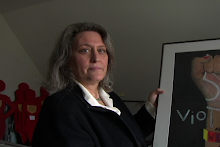
Just got back to NY from the Minneapolis - St. Paul International Film Festival, where "Power and Control" made its theatrical debut yesterday. It all went well -- full house, warm response, good reviews in the local press, humongous article in the morning paper about Ellen Pence (prominently mentioning the film). So it went well. Damn near perfect.
Best part was after the show. Ellen Pence had very considerately booked a room at a nearby restaurant. Ellen's entourage (including such dignitaries as Michael Paymar, Ellen's mom, and Ellen's sister) crowded around a massive table, munching on pad thai, interrupted occasionally by Ellen clinking on a glass to make a toast.
My main priority at the moment is to post some of the picture we took at the fest, which I think I'll do on Facebook.
In the meantime, some quick links:
Article on Ellen Pence in the Star Tribune.
Article in Minnesota Post. Review quote we will extract: "Equally a useful primer on aspects of domestic violence and a purely harrowing story (with a walloping twist), "Power and Control" is highly recommended."
Review in City Pages. Review quote: "A stark reminder that this kind of violence is all around us."
More photos posted at our Facebook group.
Monday, April 5, 2010
"Power and Control" opens at Minneapolis St. Paul International Film Festival
After more than two years in production, our documentary about domestic violence in America premieres in Minneapolis-St. Paul, Sun., April 18, 4:45 p.m., at the St. Anthony Main Theater. More information and tickets here.
It's fitting to open the film in Minnesota. Most of the story takes place in Duluth. In addition, two of our primary subjects, Ellen Pence and Michael Paymar, live in The Cities. These two great American activists were co-founders of the Domestic Abuse Intervention Project, 30 years ago.
Today Ellen continues to work full time in domestic violence. She was a prime mover behind a new domestic violence policy in St. Paul, called The Blue Print, that was just announced last week. Michael is a seven-term legislator representing St. Paul.
It's fitting to open the film in Minnesota. Most of the story takes place in Duluth. In addition, two of our primary subjects, Ellen Pence and Michael Paymar, live in The Cities. These two great American activists were co-founders of the Domestic Abuse Intervention Project, 30 years ago.
Today Ellen continues to work full time in domestic violence. She was a prime mover behind a new domestic violence policy in St. Paul, called The Blue Print, that was just announced last week. Michael is a seven-term legislator representing St. Paul.
Tuesday, March 2, 2010
The Paterson Case
The Paterson scandal somehow makes me feel very sad. Paterson has always struck me as a bright man, operating way over his head, who stumbled into something he probably would rather avoid. What an idiotic blunder to obstruct justice by intervening in an alleged domestic assault. He can't claim he didn't know any better: Paterson has been known for being out front on domestic violence issues.
It blows the mind to think that the Paterson case comes right on the heels of the Hiram Monserrate fiasco, in which a New York State Senator was kicked out of the legislature following his conviction for a domestic assault misdemeanor. It was during the debate in Albany around the Monserrate expulsion that legislators were actually quoted discussing the role of power and control in relationships with abusers.
All this comes at a crucial juncture for the making of the documentary, "Power and Control: Domestic Violence in America." In fact, we finish the project tomorrow, after almost three years of work. We're wrapping up the main feature (64 mins), the "educational" version (50 mins), as well as a special film for law enforcement and another special film for doctors, nurses and others in the health system.
We're waiting to figure out where the film is going to be shown for the first time. For obvious reasons, I'm hoping the premiere will be in New York.
It blows the mind to think that the Paterson case comes right on the heels of the Hiram Monserrate fiasco, in which a New York State Senator was kicked out of the legislature following his conviction for a domestic assault misdemeanor. It was during the debate in Albany around the Monserrate expulsion that legislators were actually quoted discussing the role of power and control in relationships with abusers.
All this comes at a crucial juncture for the making of the documentary, "Power and Control: Domestic Violence in America." In fact, we finish the project tomorrow, after almost three years of work. We're wrapping up the main feature (64 mins), the "educational" version (50 mins), as well as a special film for law enforcement and another special film for doctors, nurses and others in the health system.
We're waiting to figure out where the film is going to be shown for the first time. For obvious reasons, I'm hoping the premiere will be in New York.
Saturday, February 6, 2010
Ellen Pence Day in Duluth
Duluth honored Ellen Pence yesterday with a ceremony at City Hall declaring "Ellen Pence Day." Ellen co-founded the Domestic Abuse Intervention Project about 30 years ago, and was also co-creator of the power and control wheel. She was recently diagnosed with terminal breast cancer.
Ellen appears in "Power and Control: Domestic Violence in America," and her gently persuasive intelligence and unpretentious manner are a huge part of the film.
Ellen appears in "Power and Control: Domestic Violence in America," and her gently persuasive intelligence and unpretentious manner are a huge part of the film.
Wednesday, December 30, 2009
On the Philadelphia Domestic Violence Spike
The NYT carries an excellent story by Ian Urbina (click here) on an increase in domestic violence homicides in Philadelphia this year and broadens the scope to report on the nationwide domestic violence increase and simulaneous service cutbacks. In Philadelphia, DV homicides surged by 67% (to a total of 38) in 2009, at a time when overall homicides dropped by 9 percent.
On Monday, the Times ran two stories, which -- between the lines -- show a similar trend here in NYC. First was the report of a record-low homicide rate in the city for the year. But on the same day, the paper reported a marked increase in the number of "family offenses" in the court -- an increase from about 65,000 to 75,000 cases (click here).
Many observers are attributing the increase in domestic violence cases to the recession. These past two years of economic calamity seem to be correlated with a big jump in family violence around the country -- a trend which has yet to be officially confirmed by national data, but which is very apparent in numerous reports coming in from everywhere. We first discussed these developments about a year ago (click here for the previous blog).
This deeply troubling new development comes after many years when domestic violence seemed to be trending downward. There's some debate about why the decrease occurred. Some argue that tougher DV enforcement -- mandatory arrest in most states, no drop prosecution of offenders -- played a role, along with increased support for survivors. Others argue that the decrease can be attributed to demographic trends, such as couples getting married at an older age and an increase in the divorce rate, as well as to the overall drop in violent crime.
If this year's trend continues, let's hope that it's at least a wake up call for those in government, academia and the media who have lost interest in the domestic violence issue. We're fascinated by domestic violence as it pertains to Charlie Sheen, Tiger Woods, and Rhianna, but attention flags when it comes to seriously examining the tragic persistence of family violence in our society.
Addendum/Jan. 3. I missed some excellent reporting on the nationwise increase in domestic abuse. Philip N. Cohen blogs on the Philadelphia report and others, citing this strong report by Christina Davdison for the Atlantic.
On Monday, the Times ran two stories, which -- between the lines -- show a similar trend here in NYC. First was the report of a record-low homicide rate in the city for the year. But on the same day, the paper reported a marked increase in the number of "family offenses" in the court -- an increase from about 65,000 to 75,000 cases (click here).
Many observers are attributing the increase in domestic violence cases to the recession. These past two years of economic calamity seem to be correlated with a big jump in family violence around the country -- a trend which has yet to be officially confirmed by national data, but which is very apparent in numerous reports coming in from everywhere. We first discussed these developments about a year ago (click here for the previous blog).
This deeply troubling new development comes after many years when domestic violence seemed to be trending downward. There's some debate about why the decrease occurred. Some argue that tougher DV enforcement -- mandatory arrest in most states, no drop prosecution of offenders -- played a role, along with increased support for survivors. Others argue that the decrease can be attributed to demographic trends, such as couples getting married at an older age and an increase in the divorce rate, as well as to the overall drop in violent crime.
If this year's trend continues, let's hope that it's at least a wake up call for those in government, academia and the media who have lost interest in the domestic violence issue. We're fascinated by domestic violence as it pertains to Charlie Sheen, Tiger Woods, and Rhianna, but attention flags when it comes to seriously examining the tragic persistence of family violence in our society.
Addendum/Jan. 3. I missed some excellent reporting on the nationwise increase in domestic abuse. Philip N. Cohen blogs on the Philadelphia report and others, citing this strong report by Christina Davdison for the Atlantic.
Thursday, October 8, 2009
The Stark-Dutton Debate
One of the main strands of our domestic violence documentary film is a debate between leading lights of the mainstream domestic violence world and their critics, mostly from academia. In domestic violence, the mainstream approach is the view that at one time was radical, the viewpoint that was developed in the 1970s by the battered women's movement. The essential idea is that domestic violence stems from the patriarchal values of our society, and the related policy prescriptions have included mandatory arrest and batterer education programs.
The critics in academia claim to have an empirically based approach, one that challenges the mainstream assumptions. These critics question the significance of patriarchal values, and instead look at psychological and socio-economics factors.
A fascinating new window into this debate can be found -- of all places -- on the web sites of Fathers & Families and also on the site of Glenn Sacks, the men's rights radio host and pundit.
Evan Stark, a Rutgers professor and member of the "Power and Control" board of advisors, and Donald Dutton, a psychologist at the University of British Columbia who also appears in the film, engage in an online debate that's being carried jointly on the sites. The format is a point, counterpoint series of postings and responses from the two experts.
I was thrilled to come across this debate. It's great to see two impressive thinkers I've met in the course of shooting the film appearing in another forum. To follow the debate, go to these links:
Part I: Evan Stark on the prospects for changes in domestic violence policy during the Obama administration.
Part II: Dutton on the same question about domestic violence policy and Obama.
Part III: This is Part II of Evan's answer to the first question!
Part IV: Stark responds to Dutton.
Part V: Dutton responds to Stark
Part VI: Stark responds to Dutton. (Link good as of 10/20. Check back for updates)
The critics in academia claim to have an empirically based approach, one that challenges the mainstream assumptions. These critics question the significance of patriarchal values, and instead look at psychological and socio-economics factors.
A fascinating new window into this debate can be found -- of all places -- on the web sites of Fathers & Families and also on the site of Glenn Sacks, the men's rights radio host and pundit.
Evan Stark, a Rutgers professor and member of the "Power and Control" board of advisors, and Donald Dutton, a psychologist at the University of British Columbia who also appears in the film, engage in an online debate that's being carried jointly on the sites. The format is a point, counterpoint series of postings and responses from the two experts.
I was thrilled to come across this debate. It's great to see two impressive thinkers I've met in the course of shooting the film appearing in another forum. To follow the debate, go to these links:
Part I: Evan Stark on the prospects for changes in domestic violence policy during the Obama administration.
Part II: Dutton on the same question about domestic violence policy and Obama.
Part III: This is Part II of Evan's answer to the first question!
Part IV: Stark responds to Dutton.
Part V: Dutton responds to Stark
Part VI: Stark responds to Dutton. (Link good as of 10/20. Check back for updates)
Subscribe to:
Posts (Atom)

 Posts
Posts