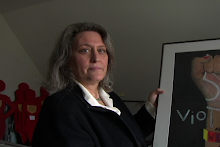
The Times ran a fascinating story last week (here) about New York City alleged domestic violence inmates who incriminate themselves in recorded jail house conversations.
Jail policy was changed to allow recording in 2007, and the installation of a digital recording system was completed last year. With the recording system in place, alleged batterers being held in city jails have been caught pressuring and cajoling their partners to change testimony or not appear in court. In many cases, the fact that the partners were even visiting represented a violation of a protection order. Prosecutors say that the recordings have been particularly useful in cases of "no drop" prosecution -- cases where the victim has declined to testify against the abuser -- which happens 75 percent of the time, according to the NYT.
Well known domestic violence prosecutor and family justice center innovator Casey Gwinn believes that the new system represents a huge breakthrough. He told the Times: "'When you’re talking about domestic violence cases,' Mr. Gwinn said, 'this policy of monitoring every jail call is probably the single most important investigative procedure put in place in the last decade anywhere in the country.'"
Showing posts with label domestic abuse. Show all posts
Showing posts with label domestic abuse. Show all posts
Wednesday, March 2, 2011


Monday, April 19, 2010
The Festival: A Huge Hit!

Domestic violence notables arrive for Film Fest.
Just got back to NY from the Minneapolis - St. Paul International Film Festival, where "Power and Control" made its theatrical debut yesterday. It all went well -- full house, warm response, good reviews in the local press, humongous article in the morning paper about Ellen Pence (prominently mentioning the film). So it went well. Damn near perfect.
Best part was after the show. Ellen Pence had very considerately booked a room at a nearby restaurant. Ellen's entourage (including such dignitaries as Michael Paymar, Ellen's mom, and Ellen's sister) crowded around a massive table, munching on pad thai, interrupted occasionally by Ellen clinking on a glass to make a toast.
My main priority at the moment is to post some of the picture we took at the fest, which I think I'll do on Facebook.
In the meantime, some quick links:
Article on Ellen Pence in the Star Tribune.
Article in Minnesota Post. Review quote we will extract: "Equally a useful primer on aspects of domestic violence and a purely harrowing story (with a walloping twist), "Power and Control" is highly recommended."
Review in City Pages. Review quote: "A stark reminder that this kind of violence is all around us."
More photos posted at our Facebook group.
Thursday, October 8, 2009
The Stark-Dutton Debate
One of the main strands of our domestic violence documentary film is a debate between leading lights of the mainstream domestic violence world and their critics, mostly from academia. In domestic violence, the mainstream approach is the view that at one time was radical, the viewpoint that was developed in the 1970s by the battered women's movement. The essential idea is that domestic violence stems from the patriarchal values of our society, and the related policy prescriptions have included mandatory arrest and batterer education programs.
The critics in academia claim to have an empirically based approach, one that challenges the mainstream assumptions. These critics question the significance of patriarchal values, and instead look at psychological and socio-economics factors.
A fascinating new window into this debate can be found -- of all places -- on the web sites of Fathers & Families and also on the site of Glenn Sacks, the men's rights radio host and pundit.
Evan Stark, a Rutgers professor and member of the "Power and Control" board of advisors, and Donald Dutton, a psychologist at the University of British Columbia who also appears in the film, engage in an online debate that's being carried jointly on the sites. The format is a point, counterpoint series of postings and responses from the two experts.
I was thrilled to come across this debate. It's great to see two impressive thinkers I've met in the course of shooting the film appearing in another forum. To follow the debate, go to these links:
Part I: Evan Stark on the prospects for changes in domestic violence policy during the Obama administration.
Part II: Dutton on the same question about domestic violence policy and Obama.
Part III: This is Part II of Evan's answer to the first question!
Part IV: Stark responds to Dutton.
Part V: Dutton responds to Stark
Part VI: Stark responds to Dutton. (Link good as of 10/20. Check back for updates)
The critics in academia claim to have an empirically based approach, one that challenges the mainstream assumptions. These critics question the significance of patriarchal values, and instead look at psychological and socio-economics factors.
A fascinating new window into this debate can be found -- of all places -- on the web sites of Fathers & Families and also on the site of Glenn Sacks, the men's rights radio host and pundit.
Evan Stark, a Rutgers professor and member of the "Power and Control" board of advisors, and Donald Dutton, a psychologist at the University of British Columbia who also appears in the film, engage in an online debate that's being carried jointly on the sites. The format is a point, counterpoint series of postings and responses from the two experts.
I was thrilled to come across this debate. It's great to see two impressive thinkers I've met in the course of shooting the film appearing in another forum. To follow the debate, go to these links:
Part I: Evan Stark on the prospects for changes in domestic violence policy during the Obama administration.
Part II: Dutton on the same question about domestic violence policy and Obama.
Part III: This is Part II of Evan's answer to the first question!
Part IV: Stark responds to Dutton.
Part V: Dutton responds to Stark
Part VI: Stark responds to Dutton. (Link good as of 10/20. Check back for updates)
Wednesday, March 4, 2009
Linda Mills on Chris Brown
Linda Mills has been one of the more controversial figures in the domestic violence community. Her books have attracted a lot of attention, including an appearance for Mills on "Oprah." Mills, a professor and vice provost at NYU, has just been quoted in People with comments about the Chris Brown incident. Here's what Mills had to say:
But it's love, in all its complexities, that can often be the most powerful force for reconciliation for a battered woman. "They have insight into somebody in a way that none of us do," says Mills, who runs a program in Arizona that brings together couples with family members and a volunteer from the community to talk over what actually happened in a domestic-violence event. The process usually goes on for months. "The ideal might be that we can separate people who are in a violent relationship, but the problem is that that's not the reality," Mills says. "I address the reality, which is that people go back, and they're looking for avenues for the possibility of working through this issue like any other rupture in a relationship, working through this issue to the point where the violence could stop."
This is bound to provoke controversy in the domestic violence community. When Mills is given an opportunity in a mass-circulation publication to urge women in relationships with abusers to flee for safety, Mills instead speaks about working things out.
We interviewed Mills for "Power and Control" and have an excerpt from the interview on the film's main site. Some people in the DV community have objected to our including Mills in the film. It's tough for me, as the director, to face this criticism, because I have so much respect for the battered women's movement and people who work in domestic violence. But in the final analysis, I'm committed to presenting current significant ideas in domestic violence, and there's no question that Mills has had a high profile and considerable influence.
Looking forward to hearing from our readers on this one!
-- Peter Cohn
But it's love, in all its complexities, that can often be the most powerful force for reconciliation for a battered woman. "They have insight into somebody in a way that none of us do," says Mills, who runs a program in Arizona that brings together couples with family members and a volunteer from the community to talk over what actually happened in a domestic-violence event. The process usually goes on for months. "The ideal might be that we can separate people who are in a violent relationship, but the problem is that that's not the reality," Mills says. "I address the reality, which is that people go back, and they're looking for avenues for the possibility of working through this issue like any other rupture in a relationship, working through this issue to the point where the violence could stop."
This is bound to provoke controversy in the domestic violence community. When Mills is given an opportunity in a mass-circulation publication to urge women in relationships with abusers to flee for safety, Mills instead speaks about working things out.
We interviewed Mills for "Power and Control" and have an excerpt from the interview on the film's main site. Some people in the DV community have objected to our including Mills in the film. It's tough for me, as the director, to face this criticism, because I have so much respect for the battered women's movement and people who work in domestic violence. But in the final analysis, I'm committed to presenting current significant ideas in domestic violence, and there's no question that Mills has had a high profile and considerable influence.
Looking forward to hearing from our readers on this one!
-- Peter Cohn
Subscribe to:
Posts (Atom)

 Posts
Posts